Our job is to protect women and men at work. To this effort, we design and manufacture complete personal and collective protection solutions for professionals worldwide.
Our job is to protect women and men at work. To this effort, we design and manufacture complete personal and collective protection solutions for professionals worldwide.
We help you to develop your skills through training, our tutorials and our centres of expertise. Easily find all the product and regulatory information relating to our ranges thanks to our download centre.
For more than 45 years, Delta Plus designs, standardises, manufactures, and distributes globally a full set of solutions in personal and collective protective equipment (PPE) to protect professional at work.
We operate in a regulated global market in many countries. Thus, we must manage requirements that may vary greatly between countries or regions.
The common goal of our product managers and services is to offer reliable, sustainable, high-performance products in compliance with the regulations and/or standards of each territory where they are used.
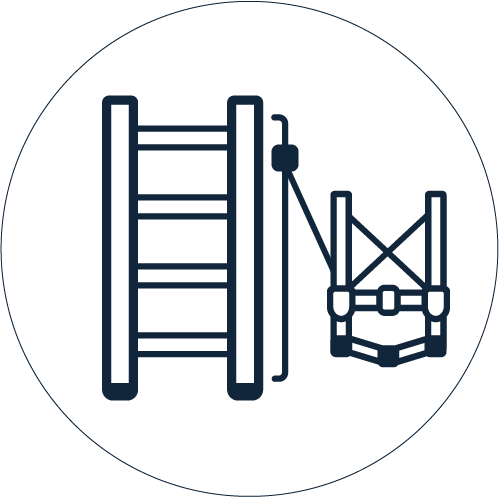
Fall arrester with self-locking device and a self-retractable system for the lanyard. An energy reducer (absorber) can be built-in in the equipment.
EN ISO 20471
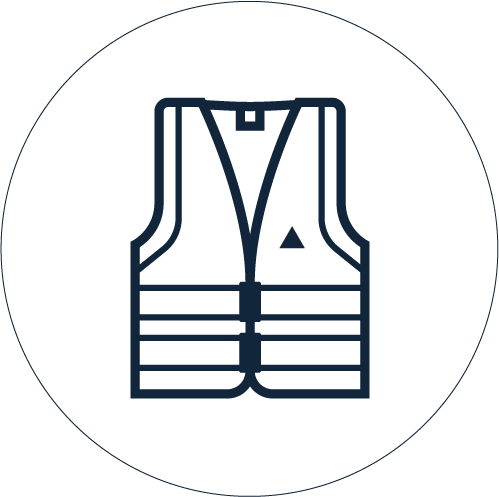
HIGH VISIBILITY CLOTHING
This standard specifies the requirements for protective clothing aiming to signal the presence of the wearer visually, so that he may be detected and seen in hazardous situations, in all conditions of daylight, and night under illumination of car headlights.
There are three classes of high-visibility clothing. Each class must have minimum surfaces of visible material constituting the garment; the higher the class, the more visible the garment:
Class 3
Class 2
Class 1
Background material (Fluorescent)
0,80 m²
0,50 m²
0,14 m²
Retroreflective material (Bands)
0,20 m²
0,13 m²
0,10 m²
Marking :
X : Class of high visibility surface (from 1 to 3)
EN ISO 20471
2 Max. 25x
EN ISO 20471
2 : Class of hight visibility surface (from 1 to 3)
Max. 25x : Optional marking, number of maximum washes authorized for the model. On this example: 25 washes maximum (see indication of service temperature on the garment tag).
EN388 : ISO 23 388 MECHANICAL RISKS
The EN388 standard applies to all types of protective gloves with respect to physical and mechanical aggression from abrasion, cutting from slicing, perforation and tearing. Since the 2016 version of the standard, new optional performance have appeared.
TEST
Level 1
Level 2
Level 3
Level 4
Level 5
Abrasion resistance
(Number of cycles)
100
500
2,000
8,000
-
Blade cutting resistance (index)
1.2
2.5
5
10
20
Tear resistance (N)
10
25
50
75
-
Puncture resistance (N)
20
60
100
150
-
Impact resistance on the metacarpal area: if this performance is claimed, the "P" mark appears.
Marking example:
4233X P
TEST CUT RESISTANCE
EN ISO 13997 (TDM
LEVEL A
LEVEL B
LEVEL C
LEVEL D
LEVEL E
LEVEL F
APPLIED FORCE (N)
2
5
10
15
22
30
Marking example:
4543D ou 4X43D
Cut by blade, 2 test methods:
EN388 6.2.: For low to middle risk of cutting. A circular blade on which a constant force of 5 N is applied, moves back and forth until the sample is cut. It measures the number of completed cycles and is credited with the corresponding level.
EN ISO 13997: For materials that blunt the blade during the EN388 6.2 test and/ or are particularly resistant, for high risk of cutting. A straight blade makes a single movement of 20 mm with a force of 2N, the test is repeated with a different force as many times as necessary until the sample is cut. A level corresponding to the force required to cut the sample is assigned. This method better represents the usage situations that present a high risk of cutting.
EN 343
PROTECTIVE CLOTHING AGAINST RAIN
This standard specifies the requirements and test methods applicable to the materials and seams of protective clothing against foul weather (for example precipitation in the form of rain or snow), fog and ground humidity.
y : Class of resistance to water penetration (1 to 4), Wp
y : Class of water vapour resistance (1 to 4), Ret
R : Water tower test on whole garment (optional)
FINNMARK2
EN343
3
1
X
DEFINITIONS
THERMAL RESISTANCE (Rct) IN M².K/W:
Measurement of the thermal insulation provided.
Divided into 4 classes (from 1 to 4) from the least insulating to the most insulating.
The higher the value, the greater the thermal insulation.
AIR PERMEABILITY (AP) IN MM/S :
Determines the complex's permeability to air.
Divided into 3 classes (from 1 to 3) from the least airtight to the most airtight.
RESULTANT EFFECTIVE THERMAL INSULATION :
Measured on moving dummy (/cler).
The thermal insulation coefficient, expressed in m².K/W, is used to determine the optimum usage temperature of the garment in relation to the individual's activity and his exposure time.
Thermal insulation is measured with undergarments of type:
(B) for ensembles (Undershirt with long sleeves, long underpants, socks, bootee + thermojacket, thermopants, knitted gloves, balaclava)
(R) for garments (Undershirt with long sleeves, long underpants, socks, bootees, jacket, trousers, shirt, knitted gloves, balaclava)
(C) provided by the manufacturer
WATER VAPOUR RESISTANCE (Ret) IN (M².PA)/W :
Measures the evaporative resistance, i.e. the product's obstacle to the passage of water vapour, or the barrier it offers to evaporation of transpiration on the surface of the skin. The higher a product's water vapour resistance, the greater this product's barrier to the passage of water vapour :
A breathing product has a low water vapour resistance.
Divided into 4 levels (from 1 to 4) from the least breathable to the most breathable.
Water vapour resistance Ret Class
Class
1
2
3
4
M2 - Pa w
Ret > 40
25 < Ret > 40
15 < Ret > 25
Ret < 15
RESISTANCE TO WATER PENETRATION (WP) IN PASCAL:
Measurement of the outer material and seams' resistance to water penetration under a water pressure of (980+/-50) Pa/min.
Divided into 4 levels (1 to 4) from the least impermeable to the most impermeable.
Water penetration resistance WP
Class
1
2
3
4
Specimen to be tested:
Material before treatment Material after each pre-treatment